By Christopher Hector
Photography: ridehesten.com
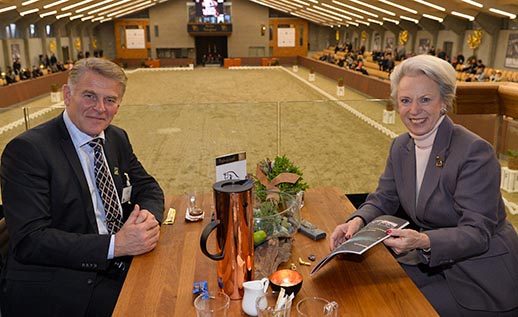
In 1999, Jan Pedersen – the young president of Danish Warmblood – was elected to take over from Gert Jan van Muijen as the president of the World Breeding Federation for Sport Horses. At the same time, HRH Princess Benedikte of Denmark, a keen sport horse breeder herself, succeeded HRH Princess Anne as the Federations patron. With a supportive and unified Board, Pedersen has been continuously re-elected, now serving his seventh term which runs until 2020.
During his presidency, there have been numerous developments, and the WBFSH has evolved into a globally recognized Federation and a forum for breeders in every corner of the world. Breeding News for Sport Horses has been a proud supporter since the publication’s foundation in 1997, and in January 2019 – in changing its name to World Breeding News (WBN) – officially partnered with the WBFSH in order to provide a global platform, a communications network for studbooks wishing to promote their activities to a more global audience and, thereby, create a shop window to attract prospective sponsors.
It's been 10 years since I interviewed you last, what do you think are the most important developments for the WBFSH in that decade?
I think that the studbooks are much more supportive now than they were at the beginning. In the beginning they were a little bit afraid that the World Breeding Federation would get too powerful – now I think everybody realises that it is important to cooperate. Everyone recognizes that horse breeding has become an international affair and, therefore, it has to be internationally organized. That is one clear development. One example, ten years ago we were working with the Inter-Stallion Project, and at the time some studbooks were afraid of the transparency, but now everybody realises that it is the way to go forward.
I read that report and I was thinking about it when I came here to the Young Dressage Horse Championships in Ermelo, so okay we can look at the marks and then analyze the influence of the stallions and stallion lines, but how do we deal with the rider factor? Even theoretically, how do we deal with the fact that this horse is ridden by Charlotte Dujardin, that one ridden by me?
That is what is possible with our new system, you take that into account. The rider effect, also the mare line, not only the stallion but who is the mother of this horse, everything will be taken into account, along with the rider effect. I don’t know now how we are going to manage it, but it will be taken into account.
In England, there is a very sophisticated statistical analysis done by EquiRatings on the sport of eventing, so they know in advance this horse is likely to get an X score in the dressage, but if this horse and all the others is, say, six marks better than their usual scores, then the results are re-assessed to take into account a ground jury that is being unusually generous, that works because they are working on a more or less level playing field. But how do we take into account the fact that a 1m60 showjumping class in Germany is very different from a 1m60 track in Australia, the degree of difficulty is way higher in the German example...
That too will have to be taken into account, and we will be working on that, it is complicated, it is going to be very expensive also, and it is not going to happen tomorrow.
You say that studbooks are now more supportive of the WBFSH, but is that because the studbooks now feel threatened? Ten years ago someone said, I am a Hanoverian breeder and I will always register my horses with the Hanoverian Verband, now breeders go to whatever book suits them?
I think that is part of the explanation. Years ago, when I was young, the breeders would be very loyal to their studbook, a Hanoverian breeder would only support the Hanoverian studbook, that has changed a lot. Today the breeders shop around. Which studbook is cheaper? Which studbook has the best auctions? People are not loyal to one studbook any more, so I think we are going to see that the number of studbooks is going to be reduced. That is part of the reason that the studbooks are more supportive to the World Breeding Federation.
Even at this show, if we look at the new world champion six-year-old, Zucherro, bred by one of Hanover’s well known breeders, Hans-Heinrich Brüning, but registered Oldenburg because at the time, Zonic was not approved for Hanover - that would not have happened 15 years ago...
No, it has changed a lot, you see a Hanoverian horse, registered with Oldenburg and ridden by a Danish rider, for instance, it has changed a lot.
The other thing that has changed is that once in the past we would say of certain breeding organizations, ‘oh, that’s not really a studbook, it is just a registry,' but now when you look at say the Anglo European registry, the number of horses registered with them that are performing at the top level in competition, is quite high...
I think it has to do with the fact that it is uncomplicated and it’s cheap.
Is that the way of the future?
I don't think so... at least I hope not, because that would not bring the breeding forward...To read the complete article you need to be a subscriber
SUBSCRIBERS CAN READ THE COMPLETE ARTICLE BY LOGGING IN AND RETURNING TO THIS PAGE