BY KATRIEN PALMERS DVM, EUROPEAN SPECIALIST IN EQUINE INTERNAL MEDICINE (DIPLOMATE ECEIM), EQUITOM EQUINE HOSPITAL | EQUINE CARE GROUP
GRAPHICS: COURTESY EQUITOM; BIOAGENTS
In early August 2026, the first locally acquired case of West Nile virus (WNV) infection in a horse in Belgium was admitted to an Equine Care Group hospital. The horse developed severe neurological disease and unfortunately did not survive.
By October 2026, approximately 50 equine cases had been reported in Belgium—an extraordinary increase in a country where none had previously been reported. The true number is probably higher: testing has largely focused on horses showing clinical signs of neurological disease, while many infections remain asymptomatic. Several affected horses have since been treated at our hospitals, and the majority have recovered well, returning to their usual life.
This sudden emergence should prompt awareness, not panic. Most infected horses remain asymptomatic or develop only mild signs. Nevertheless, a minority develop severe neurological disease. For equine clinicians and owners worldwide, the Belgian experience raises an important question: as environmental and climatic conditions change, are the diseases we encounter in everyday veterinary practice changing too?
What is West Nile virus, and where does it occur?
West Nile virus (WNV) is a mosquito-borne virus maintained primarily in a transmission cycle between wild birds and mosquitoes. It was first identified in 1937 in the West Nile district of Uganda, from which it takes its name. The virus is now found across large parts of Africa, the Middle East, Asia, North America and Europe.
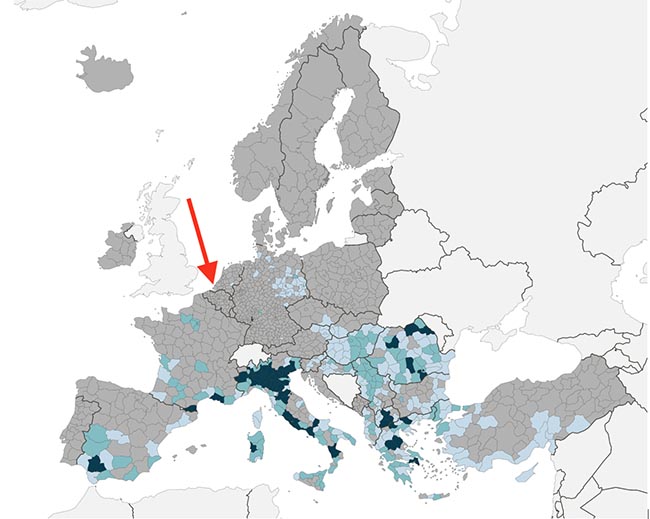
WNV is not new to Europe. Equine and human infections have been documented for years in countries including Italy, Greece, Spain, France, Hungary, Romania, and the Balkans.
Its geographical range has increasingly extended northward, with sporadic infections also documented in Germany, Austria, and the Netherlands. Equine cases in northern Europe therefore predate the Belgian outbreak, although their occurrence had been more limited or sporadic in some areas.
Belgium had not previously reported locally acquired equine cases. However, WNV was detected in wild birds in 2025 and again in 2026. In early August 2026, the first confirmed locally acquired equine case was identified and treated at our hospital. Within weeks, further equine cases appeared. Approximately 50 had been reported by October, suggesting substantially more transmission than the initial case alone would have implied.
This is a significant epidemiological change: local circulation between birds and mosquitoes is now established in Belgium. Similar developments elsewhere in northern Europe illustrate why WNV should be considered beyond its traditional southern European range.
◆ Should every mosquito bite be a cause for concern?
No! A mosquito must first acquire the virus by feeding on a bird with sufficient viraemia. Only an infected mosquito can subsequently transmit WNV to a horse or human. Furthermore, only a minority of infected horses develop obvious clinical disease. Infection does not automatically mean that a horse will become seriously ill.
◆ Why does WNV occur mainly in summer?
WNV transmission depends on mosquitoes. In Europe, Culex mosquitoes, including the common house mosquito complex, are particularly important vectors.
Mosquito activity and viral transmission are influenced by temperature and water availability. Most infections therefore occur during the mosquito season, broadly from May to October in much of Europe, with the greatest risk often occurring during warmer months.
Wetlands and water-rich landscapes provide favourable mosquito habitats, but extensive marshes are not required. Ponds, ditches, flooded pastures, rain barrels and even small containers of stagnant water may create breeding sites. The first horses treated at our hospitals originated from an area with numerous waterways and flood-prone landscapes...
CLICK HERE TO READ THE COMPLETE ARTICLE IN THE ONLINE EDITION OF BREEDING NEWS