BY ED BALCEWICH
PHOTOS: JUMP MEDIA; CHLOE MELNYCHUK/CB MEDIA; WORLD OF SHOWJUMPING
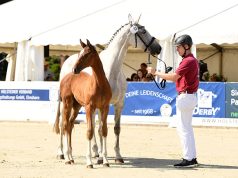
The cover of our June 2021 issue, #294, featured a beautiful image of a Selle Français mare with her miracle blue-blooded twin foals, born in rural Manitoba, Canada. Their birth was the result of a decision made at that time by breeding partners Ed Balcewich and Jeff From. Ed now picks up the story, to date.
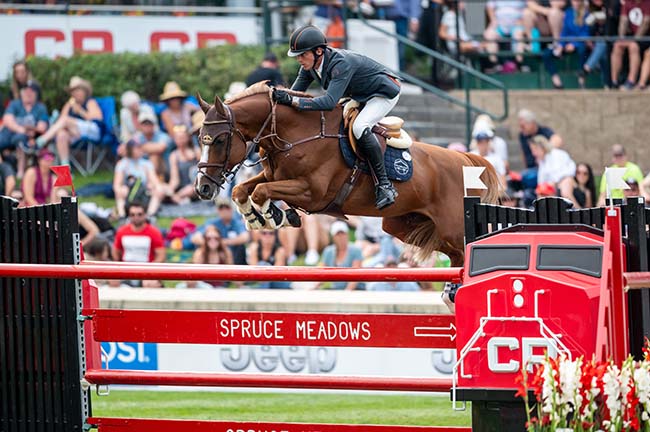
At the 2019 Spruce Meadows Masters, the International Ring was doing what it does better than almost anywhere in the world: putting horses and riders under real pressure. We had front-row seats for the $3 million CP International Grand Prix, close enough to feel the atmosphere tighten with every clear round and close enough to watch the best in the world answer the kind of questions only Spruce Meadows can ask. Then Beezie Madden and Darry Lou came into the ring. Their victory was impressive, but what truly stood out was Darry Lou’s jump. He was quick off the floor, exceptionally careful, sharp in his reflexes, and always in balance. Under Beezie, he looked like a complete jumper: blood, scope, carefulness, responsiveness, and control all working together in one horse. For most breeders, a performance like that raises a familiar question: how do you breed another one?
That afternoon, though, my attention shifted away from the result and toward the structure behind it. Horses like Darry Lou do not come from nowhere. They come from pedigrees that have already shown an ability to combine the qualities the sport demands. When I went back through his pedigree, what struck me was not only how modern it was, but how familiar parts of it felt.
At Desiderius Farms in St. Andrews, Manitoba, where I breed horses with Jeff From and Nehal Jora, some of our mares carried remarkably similar architecture. Years later, that question would come back into sharper focus through Halo DF, one of the SF miracle twins born in our own program. That was the starting point for what we eventually began calling Framework Linebreeding.
It was not a grand theory at first. It was simply an observation: if certain bloodlines have already shown that they can consistently produce the type of horse breeders value, it may make more sense to stay close to those structures than to start from zero each time.
Across 12 Generations
Darry Lou and Halo DF share many of the same ancestors in many of the same generational positions, making the similarity in their underlying framework easy to see.
The Gretzky lesson
To explain variance, I often reach for hockey. That is partly because I live in Canada, where hockey is woven into the culture, and partly because Wayne Gretzky offers such a clear example. For readers outside North America, Gretzky is the undisputed GOAT – the Greatest of All Time – in hockey...
CLICK HERE TO READ THE COMPLETE ARTICLE IN THE ONLINE EDITION OF BREEDING NEWS