By Dr Tatiana Gojdyk, DVM, ECEIM Resident
Photography: Courtesy Equitom
What is a colic? It’s the manifestation of pain from a horse, coming from the abdomen, pelvis, or thorax. Horses don’t have a lot of means to express their pain, and being prey animals will reluctantly do so.
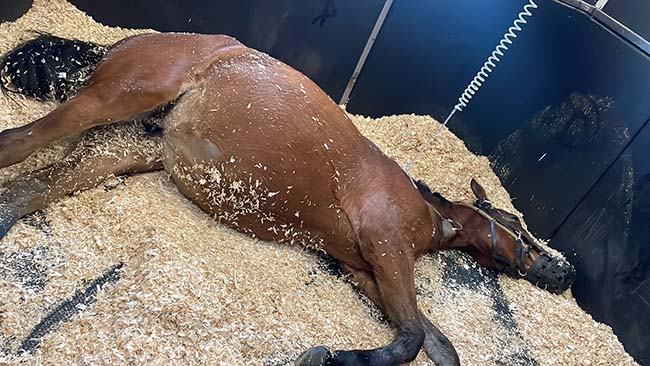
Any sign of colic must be taken into serious consideration, be it pawing the ground, looking at their flanks, lying like a cow, or laterally like a dead horse for prolonged periods of time (Figure 1), having extreme bouts of excitation and sweating profusely, yawning repeatedly, being really grumpy (change of behavior), or reluctant to move or loosing weigh (Figure 2).
Sometimes colics can be called recurrent, ranging from more than three episodes of colic per year to more than three episodes of colic per month. It is of course a very serious problem, both from an ethical point of view to a poor performance issue.
This article aims to review the main problems encountered when a team of dedicated veterinarians look into the reason for recurrent colics, and how to make a precise and complete diagnosis.
Dental problems
Horses are mammals with ever-growing teeth and are born with two sets:
• the lacteal, which they will shed like good kids waiting for the tooth fairy,
• and decidual, that are hidden entirely within their head bones, progressively come out, and will be slowly worn down throughout a horse’s whole life.
However, some pathologies exist, including eruption defaults or bad wearing bringing imbalance to the entire mouth and the chewing system. Some teeth can be fractured or present cavities, and older horses often have more problems that need to be followed closely.
Let’s remind ourselves that a well-balanced mouth is a supple mouth, and that chewing is the first part of digestion.
A good dental examination is essential to the well-being of your horse, which often involves sedation. Indeed, horses being prey animals, it is scary for them to be immobilized with their mouth open, so they contract their extremely strong jaw muscles to fight against us. The mouth of a horse is long and narrow, a bit like a crocodile’s, and in order to do a good job, good relaxation needs to be achieved.
Gastric ulcers
One of the most common problems encountered in the equine world is equine gastric ulcers syndrome. It is deeply linked to the amount of stress and feed our horses receive daily...
CLICK HERE TO READ THE COMPLETE ARTICLE IN THE ONLINE EDITION OF BREEDING NEWS