BY INGA WOOLFRAM; FRANCES A. LE BELLE, YTEKE ELTE
GRAPHICS AND TABLES: THE AUTHORS
To give the report its full title: “What is welfare? A qualitative study into perceptions of equine welfare of the Dutch equestrian community.” There are obvious discrepancies between knowing and successfully doing something...
So while we do need to continue to work on education, training, and fostering an environment where “living welfare” is normal, there is quite a bit of awareness already out there, and the equine sector must do more to position itself as contributing positively towards wider societal issues. At present, many of the barriers to being able to apply welfare standards are related to equine businesses often being considered a bit of a nuisance or misunderstood. As a result, they run into spatial restrictions or issues with planning permissions that might be resolved more easily if the broader contributions to social, ecological and economic aspects were better understood.
Abstract
Equine welfare is an increasingly important topic in the Netherlands and abroad. While existing literature broadly captures equine welfare concerns, research focused on Dutch horse enthusiasts is sparse. This study aims to identify what aspects horse enthusiasts in the Netherlands consider essential to safeguard equine welfare.
An online survey comprising four binary yes-no questions, and 12 open questions was disseminated via social media. Survey data were analysed qualitatively using inductive thematic analysis.
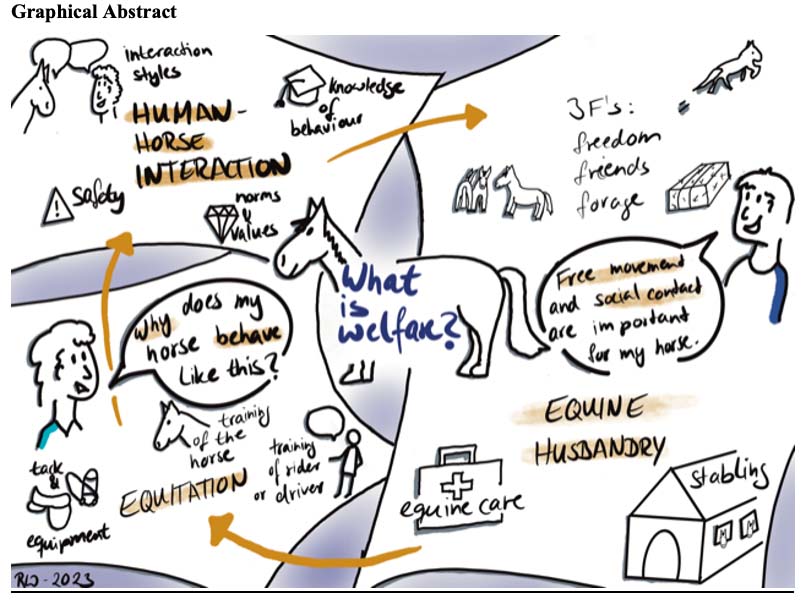
The survey received 875 complete responses. Thematic analysis led to the identification of three higher order themes: Equine Husbandry, Human-Horse Interaction, and Equitation. Aspects relating to Equine Husbandry were mentioned most, suggesting that Dutch equine enthusiasts consider aspects relating to housing and management more important to overall equine welfare. Within this theme, lower order themes such as the ability to perform natural behaviour and feeding were most prominent. On the theme of Human-Horse Interaction, respondents highlighted the importance of understanding horse behaviour and human-horse communication to ensure their welfare, as well as ethical considerations for treating horses as sentient beings deserving respect. On the theme of Equitation, various aspects of training the rider and the horse were highlighted, including a sound knowledge of tack and equipment. Respondents emphasised the importance of qualified instruction on horse care and welfare.
Despite evident awareness of a wide variety of welfare aspects among equestrians, considerable discrepancy between knowledge and practice persists, pointing to the need for tailored education and training to facilitate better application of welfare principles.
Introduction
In recent years, against the backdrop of high-profile incidents of equine mismanagement and abuse (Bruno, 2024; Mather, 2021; Murray, 2023, 2024), the topic of equine welfare and how to safeguard it has become increasingly important. This growing concern is understandable, given the significant role horses play in society, through a wide range of activities, from recreational pursuits to competition at the highest level, from breeding, training and trading of horses to coaching and therapeutic practices. (Campbell, 2021; Evans et al., 2022; Holmes & Brown, 2022; Pearson et al., 2023; WhiteLewis, 2020)...
CLICK HERE TO READ THE COMPLETE ARTICLE IN THE ONLINE EDITION OF BREEDING NEWS