

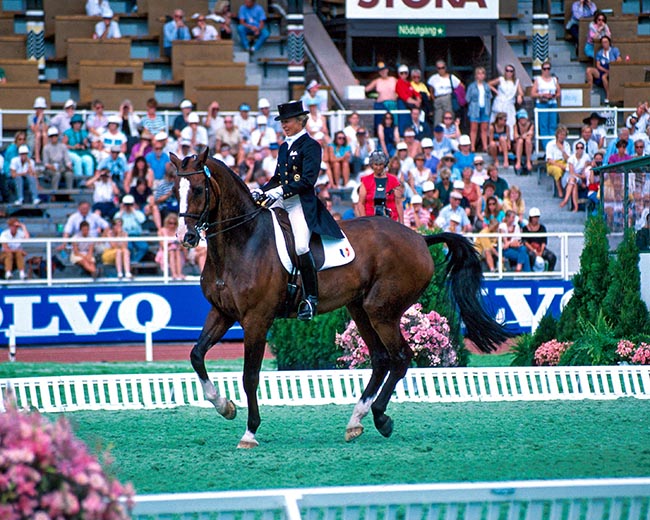
BY DR. P.H. BIRDSALL
PHOTOGRAPHY: PETER LLEWELLYN; FEI/LEANJO DE KOSTER
At the 2026 FEI Jumping World Championship in Aachen, all 10 of the top-10 horses traced to Cor de la Bryère; nine of them within five generatioons. Across those 10 pedigrees there are 19 separate crossed to Cor, through nine of his offspring. For a stallion foals in 1968 that’s a remarkable hold on the sport’s best horses.
But a finding like that raises two questions it cannot answer on its own. By what routes does his blood arrive? And is a concentration like that unusual, or is it simply what every modern jumping pedigree looks like now? To answer them we have to leave the championship and look at the whole population.
A French horse who became a German sire
Cor de la Bryère was foaled in France in 1968 and registered Selle Français. As a three-year-old, in 1971, he was imported to Schleswig-Holstein, and he stood in Holstein for the rest of his career, approved by several German breed societies.
That biography explains the shape of everything that follows. His blood entered the modern jumper through German breeding rather than French, which is why the French lines he came from carry so little of him. At Aachen, the three horses in the top 25 without him anywhere in their pedigrees were the two most strongly Selle Français-bred horses in the final and one half-Irish horse. A stallion born French became one of the foundations of the Holsteiner horse, and through the Holsteiner, of the sport as a whole.
Then and now: ten times the concentration
The clearest way to measure his rise is to compare two bodies of pedigrees: the historical archive, and the current jumping population. I counted every cross to Cor in each, five generations deep, plus one generation deeper wherever one of his offspring sits at the fifth generation with his own sire beyond the data.
In the archive he is one influence among many: most horses of that era don't carry him at all, and those that do usually carry him once. In today's population he appears 1.71 times in the average pedigree. That is more than ten times the concentration, and it understates the change, because the current figure is an average that includes the horses without him.
He is also much closer up than people assume. Of the 889 crosses in current pedigrees, 295 are at the third generation, through Caletto I, Corrado I, and the mare Fayence above all. He is not distant background blood in the way that Alme or Ibrahim are; he is a great-grandsire.
The sons that carried Cor
In the archive his leading offspring are hard to separate: six of them sit between 24 and 37 crosses, with no clear leader. Today four have pulled well ahead, one has been left behind, and the gap between the leaders and the rest has widened.
Calypso II has gone from 29 crosses to 155, and now carries more of his blood than any other offspring. Corrado I has risen from 24 to 130, Caletto II from 37 to 133, and Caletto I from 35 to 129. Calando I sits behind them on 93.
The faller is Calypso I. Level with the leaders in the archive on 28 crosses, he has reached only 39 in the current population, while his contemporaries have multiplied theirs four and five-fold. Carneval, with 10 archive crosses and six today, has almost disappeared. These are the routes that closed: sons whose own sons did not become sires in their turn...
CLICK HERE TO READ THE COMPLETE ARTICLE IN THE ONLINE EDITION OF BREEDING NEWS

